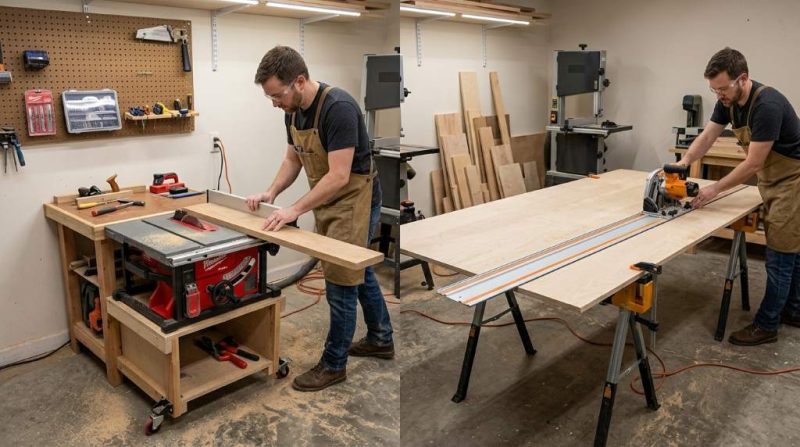
Track Saw vs Table Saw for a Small Shop
Setting up a small woodworking shop forces you to make smart choices about every tool you buy. According to a recent survey by the Woodworkers Guild of America, over 68% of hobbyist and semi-professional woodworkers operate in spaces under 400 square feet. When floor space is limited, the debate around track saw vs table saw for a small shop becomes one of the most important decisions you will make. Both tools can rip sheet goods and handle dimensional lumber, but they serve different workflows, budgets, and space constraints. Choosing the right one can define your shop’s efficiency for years to come.
Understanding the Core Difference Between a Track Saw and a Table Saw
A track saw (also called a plunge-cut saw or guide rail saw) rides along an aluminum rail to deliver precise, straight cuts. You bring the saw to the material rather than feeding the material into a blade. A table saw, on the other hand, mounts a spinning blade in a stationary table where you push the workpiece through. Both tools cut wood accurately, but the mechanics behind them create very different shop experiences. Understanding these differences is the first step toward making the right call for your setup.
How a Track Saw Works
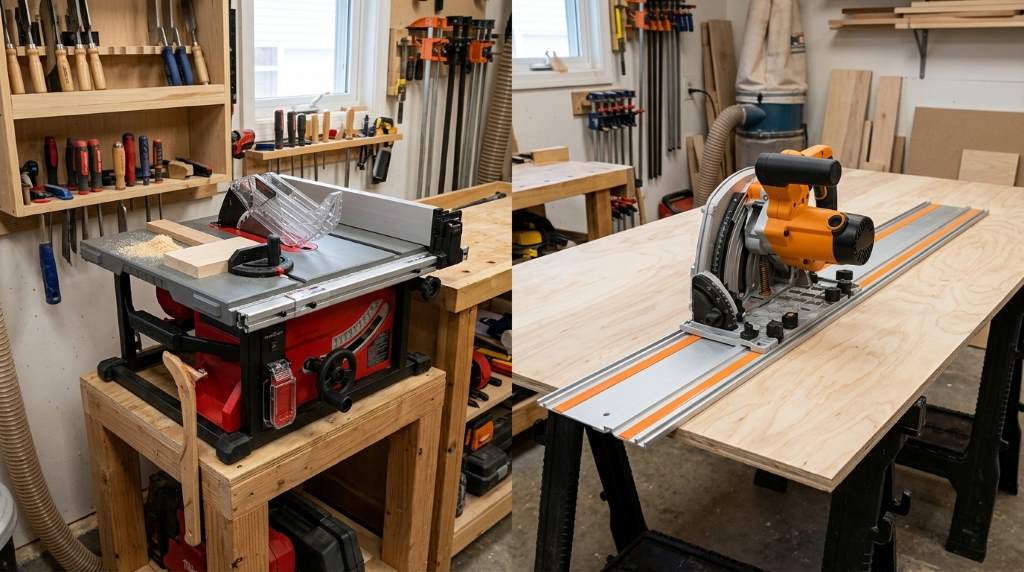
A track saw clamps an aluminum guide rail directly onto your workstock or a pair of sawhorses. You set the blade depth, position the rail, and push the saw forward in a smooth, controlled motion. Most modern track saws use a plunge mechanism so the blade never contacts the material until you are ready to cut. Brands like Festool, Makita, and Mafell lead the market with systems that produce virtually zero tearout. The result is a tool that performs more like a precision instrument than a shop workhorse.
How a Table Saw Works
A table saw centers its workflow around a fixed machine with a raised blade protected by a guard and riving knife. You rip boards, crosscut with a miter gauge, and dado joints using a single stationary platform. Contractors, cabinet shops, and serious hobbyists have trusted the table saw as the backbone of woodworking for over a century. Modern versions range from compact jobsite saws to heavy cabinet saws with cast-iron tops. The tool demands respect, space, and a solid safety routine every single time you use it.
Space Requirements: The Biggest Factor for Small Shops
When you compare track saw vs table saw for a small shop, floor space is usually the deciding factor. A standard contractor table saw requires roughly 8 to 10 feet of clearance on each side to rip a full 4×8 sheet of plywood safely. Add the saw’s own footprint and you are looking at a dedicated zone of 10 by 14 feet minimum. Many small garage shops simply cannot accommodate that kind of real estate. A track saw, by contrast, needs only a flat surface like a pair of foam insulation boards on the floor.
Track Saw Space Advantage
You can break down a full sheet of plywood on a garage floor, a folding workbench, or even a set of saw-horses with a track saw and two rigid foam sheets beneath it. After cutting, the track saw folds up and hangs on a wall hook or sits in a carrying case. This portability is a genuine game changer when every square foot of your shop serves multiple purposes. Furthermore, you eliminate the wide outfeed and side tables that a table saw demands. For many small shop owners, this single benefit alone makes the decision clear.
Table Saw Space Needs
A table saw anchors your shop around it and dictates how you arrange everything else in the room. You need infeed space, outfeed space, and lateral clearance on both sides before you can safely rip any piece of lumber longer than three feet. Even the most compact jobsite saws like the DeWalt DWE7485 or Bosch 4100XC-10 require careful planning to use in tight quarters. Rolling stands help somewhat, but you still need to clear the path before every major cut. The table saw is an excellent tool, but it genuinely needs room to breathe.
Accuracy and Cut Quality Compared
Both tools deliver accurate cuts when set up properly, but they achieve precision through different means. A well-set track saw with a sharp blade produces cuts so clean that many woodworkers skip the jointer entirely after ripping with one. A properly tuned table saw with a quality fence offers repeatable rip cuts that you can dial in to a thousandth of an inch. The accuracy question is less about which tool is better and more about which type of precision matters most to your specific work. Each approach has real strengths depending on the task.
Track Saw Precision
Track saw accuracy depends heavily on the quality of your guide rail, the condition of your anti-splinter strip, and how carefully you align the rail to your cut line. Festool’s MFT system and Makita’s SP6000J1 produce cuts that are genuinely ready for glue-up straight off the saw. However, making repeated identical rip cuts requires re-measuring and re-clamping the rail every single time, which slows production. For one-off cuts and sheet goods breakdown, the track saw is exceptional. For high-volume repetitive ripping, it starts to show its limitations.
Table Saw Precision
A quality table saw fence locks down a dimension and holds it perfectly for every single rip cut until you change the setting. This repeatability is the table saw’s greatest strength in a production or semi-production environment. You set your fence once and rip 20 identical stiles or rails without touching the measurement again. Additionally, dado stacks, molding heads, and tenoning jigs expand the table saw’s capability well beyond simple ripping. For shops that do repetitive work, this efficiency is hard to overstate.
Cost Breakdown for Small Shop Buyers
Budget is a real factor when comparing track saw vs table saw for a small shop, and the numbers might surprise you. A capable entry-level track saw from Makita runs around $350 to $450 for the saw body, but you need to add a 55-inch rail at roughly $130 and a longer 106-inch rail if you plan to rip full sheets, adding another $200. A solid jobsite table saw like the Ridgid R4521 or the DeWalt DWE7491RS with a rolling stand costs between $450 and $650 at major retailers like Home Depot and Lowe’s. Both options sit in a similar price range at the entry level, but the systems cost more as you add accessories.
Long-Term Value Considerations
A track saw system grows with you by adding rails, connectors, and compatible accessories that expand your cutting capacity over time. A table saw grows through add-ons like router tables, outfeed tables, dado sets, and upgraded fences, and these extras can add hundreds of dollars quickly. From a resale standpoint, quality track saw systems like Festool hold their value exceptionally well on the used market. Table saws are common and abundant on platforms like Facebook Marketplace, meaning you can often buy a used one at a steep discount. Think about total cost of ownership, not just the purchase price.
Safety in a Small Shop Environment
Safety in a confined space is a serious consideration that often goes undiscussed in tool comparisons. A table saw in a small shop creates sawdust and offcuts that build up fast, and kickback risk increases when you cannot maintain proper body positioning around the blade. A track saw, by design, encloses the blade within a guard at all times during the cut and returns the blade into the body at the end of each pass. This enclosed cutting action dramatically reduces the risk of blade contact. For new woodworkers or those working alone in a small space, that safety profile matters enormously.
Dust Collection in Tight Spaces
Track saws connect directly to a dust extractor through a standard 1.5-inch or 27mm port, and quality systems like Festool paired with a HEPA extractor capture over 90% of dust at the source. Table saws generate dust from the blade, the throat plate opening, and the cabinet below, making full containment more complex to achieve. In a small shop, controlling fine wood dust is not just a comfort issue but a genuine respiratory health concern. The track saw’s on-tool collection advantage becomes especially important in garages or basement shops with limited ventilation. Invest in proper dust management no matter which tool you choose.
Best Use Cases: When to Choose Each Tool
Choosing between a track saw vs table saw for a small shop ultimately comes down to the type of work you do most often. If you primarily work with sheet goods like plywood, MDF, and melamine panels, the track saw is almost always the smarter choice for a small space. If your work revolves around solid wood ripping, joinery, and repetitive dimensioning, a table saw will serve you far better in the long run. Many experienced woodworkers eventually own both, using each for what it does best. However, if you can only have one tool right now, let your most common task drive the decision.
Choose a Track Saw If You:
- Work primarily with plywood, MDF, or large panels
- Have a shop under 250 square feet
- Need a tool you can transport to job sites
- Prioritize safety and dust control above all else
- Want to avoid building a permanent outfeed table setup
Choose a Table Saw If You:
- Do a lot of solid hardwood ripping and dimensioning
- Need repeatable cuts for production-style woodworking
- Have at least 300 to 400 square feet of dedicated shop space
- Plan to add dado cuts, raised panels, or box joints to your work
- Prefer a single anchor tool around which your shop is organized
Can You Use Both in a Small Shop?
Many experienced woodworkers solve the debate entirely by using a track saw for sheet goods breakdown and a compact table saw for solid wood work. A folding workbench system lets you store the track saw flat against the wall while a compact jobsite saw rolls out on its stand only when needed. This hybrid approach maximizes versatility without permanently dedicating floor space to either machine. It does require a slightly larger budget upfront, but it removes the limitations of relying on only one tool. If your shop is around 300 to 400 square feet, a smart layout makes both tools coexist comfortably.
Final Verdict: Track Saw vs Table Saw for a Small Shop
After weighing space, safety, cost, and workflow, the track saw wins as the primary tool for most small shop owners who work primarily in spaces under 300 square feet. It offers better portability, safer operation, superior dust collection, and nearly zero footprint when stored. However, if your work demands repetitive solid wood ripping and you have space to spare, a compact table saw will deliver more productivity over time. The best choice depends entirely on your workflow, your space, and your woodworking goals. Start with the tool that matches what you actually build today, and you will never regret the decision.
Take the next step right now: measure your shop space, list the three types of cuts you make most often, and let that honest answer guide your purchase. If you found this comparison helpful, share it with another woodworker who is facing the same choice.
Frequently Asked Questions
Can a track saw fully replace a table saw in a small shop?
For sheet goods and panel work, yes, a track saw can fully replace a table saw, but it struggles with high-volume repetitive solid wood ripping.
What is the safest saw for a beginner in a small garage shop?
A track saw is generally safer for beginners because the blade is fully enclosed during and after every cut, reducing kickback risk significantly.
How much space do I really need for a table saw?
You need at least 10 feet of infeed and outfeed clearance plus side clearance, making the minimum usable zone roughly 10 by 14 feet for a standard table saw.
Is a track saw accurate enough for cabinet making?
Yes, a quality track saw with a sharp blade produces glue-ready edges accurate enough for professional cabinet making and furniture building.
Which tool holds its resale value better, a track saw or a table saw?
Premium track saw systems, especially Festool, hold resale value significantly better than most consumer-grade table saws on the used market.